If Someon Gbs Will They Breathe on There Own Again
NPR YouTube
For Tim Goliver and Luther Glenn, the worst affliction of their lives started in the same way — probably subsequently having a tummy issues.
Tim was 21 and a higher pupil at the University of Michigan. He was majoring in English and biology and active in the Lutheran church. "I was a literature geek," says Tim. "I was really looking forward to my senior year and wherever life would take me."
Luther was in his 50s. He'd spent most of his career as a U.S. military policeman and was working in security in Washington, D.C. He'd recently separated from his wife and had but moved into a new house with his two daughters, who were in their 20s.
Both men recovered from their stomach bugs, but a few days later they started to feel sluggish.
"Hither we are trying to unpack, fix ourselves for new life together, and I'm flat-out dead tired," says Luther. He fell asleep in the car i morning time and never made it out of the garage. Then he brutal in the bath.
For Tim, information technology started to experience like running a marathon merely to lift a spoonful of soup. I morning time, he tried to rummage his hair and realized he couldn't lift his arm above his shoulder. "At that moment I started to freak out," he says.
Both men got then weak that their families had to wheel them into the emergency room in wheelchairs. They got the same diagnosis: Guillain-Barre syndrome, a neurological disorder that can leave people paralyzed for weeks.
People who come down with Guillain-Barre typically have had some sort of disease a few days or weeks earlier, like the influenza, says Dr. Ken Gorson, a neurologist at Tufts School of Medicine and St. Elizabeth'south Medical Center in Boston. He'due south on the medical advisory lath of GBS/CIDP Foundation International, which is defended to Guillain-Barre syndrome.
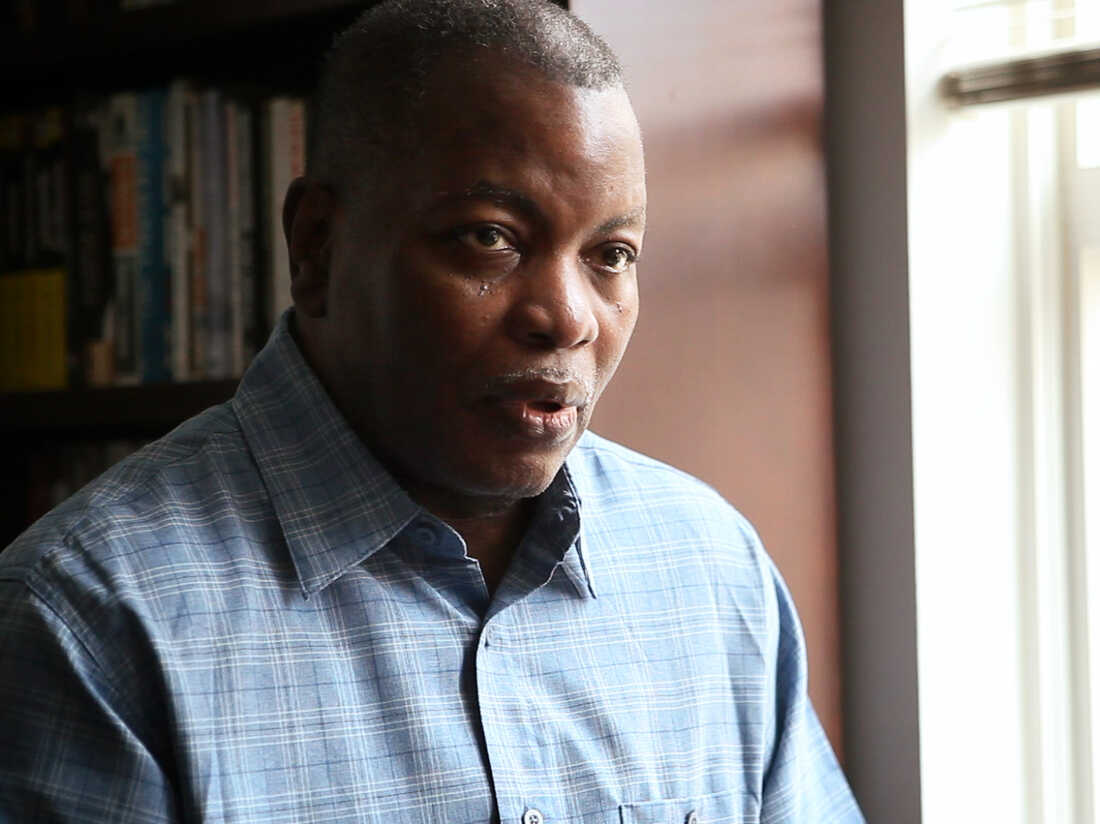
Luther Glenn adult Guillain-Barre syndrome later on coming downward with a stomach virus in 2008. He's still dealing with the consequences. Meredith Rizzo/NPR hide caption
toggle caption
Meredith Rizzo/NPR

Luther Glenn developed Guillain-Barre syndrome afterward coming down with a stomach virus in 2008. He'southward even so dealing with the consequences.
Meredith Rizzo/NPR
In many cases the trigger is a bacterial infection like Campylobacter jejuni, which sometimes contaminates undercooked craven. In super-rare cases, people accept developed Guillain-Barre after getting certain vaccines. The patient gets well, and then, "within days or a week, has terrible numbness or tingling and weakness," says Gorson.
The syndrome gets its proper name from two French military doctors, Georges Guillain and Jean Alexandre Barre. In 1916 they diagnosed two Globe War I soldiers with the affliction. The soldiers had come to the armed services hospital weak and with a tingling sensation up their arms and legs. One tried to get out at 5 a.m. to rejoin his comrades, but fell downward with his backpack on and couldn't become back up.
Here's what happens. The immune organization launches an attack against the pathogen that'due south making someone sick. Information technology succeeds, and the person gets better, but the immune system doesn't realize the battle is over and attacks stuff in the body. Unfortunately, that can include the myelin blanket around fretfulness.

Exposure to pathogens can prepare the phase for Guillain-Barre syndrome. It can get out people paralyzed for weeks. Rae Ellen Bichell and Katie Park/NPR hide caption
toggle caption
Rae Ellen Bichell and Katie Park/NPR

Exposure to pathogens can gear up the stage for Guillain-Barre syndrome. Information technology can leave people paralyzed for weeks.
Rae Ellen Bichell and Katie Park/NPR
"The immune system is by mistake attacking the peripheral fretfulness," says Gorson.
That is non skillful, considering like the insulation around an electrical wire, if the nervus coating gets damaged, the letters traveling from the fundamental nervous system to the rest of the body can become lost.
Tim and Luther were admitted to the hospital and were told to expect a quick decline. Their blood was filtered to remove the antibodies attacking their own bodies, and they received injections of antibodies from donated claret.
No matter what the cause, a diagnosis of Guillain-Barre syndrome, or GBS, usually means you're about to go through something really traumatic. You can expect to lose almost everything that makes yous you. That could mean non being able to walk, to talk — fifty-fifty to breathe.
But after weeks or months in the intensive care unit of measurement, you'll gain information technology back. Probably.
Gorson says about 80 percent of people who come up downwardly with Guillain-Barre will recover virtually fully. Very few die. And some people recover, but never fully regain their abilities. And no one knows, while in the midst of Guillain-Barre, how much they'll get dorsum.

Kelli Glenn holds a photo of her male parent while he was in the hospital. Meredith Rizzo/NPR hide caption
toggle caption
Meredith Rizzo/NPR
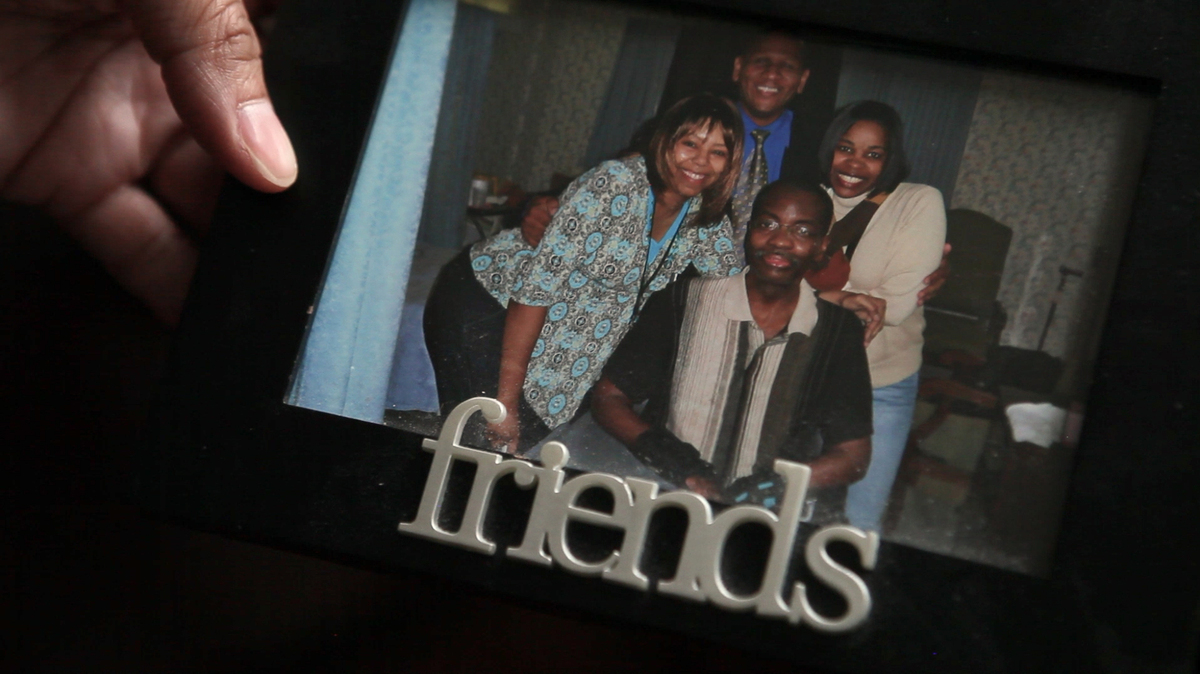
Kelli Glenn holds a photograph of her father while he was in the hospital.
Meredith Rizzo/NPR
"I was watching Boob tube and I lost employ of the right side of my face. All the muscles just sagged," says Tim, recalling the first few days in the hospital.
Within 5 days of entering the hospital, the muscle that used to elevator Tim'due south lungs for each jiff went lax, then the staff put a breathing tube down his pharynx, taping information technology to his mouth. Then he had to go on a ventilator, through a tube that went directly to his windpipe through a hole in his neck.
"Y'all feel like your body is a bellows, and you lot feel like you're beingness pumped and fanned again, again, again," says Tim.
Because Tim's nerves were under set on, every little touch on was excruciating — fifty-fifty a soft towel felt similar steel wool digging into his skin. And he'd lost command over his mouth and throat muscles, then he couldn't talk anymore. He could glimmer and nod to some extent, but that was about it.
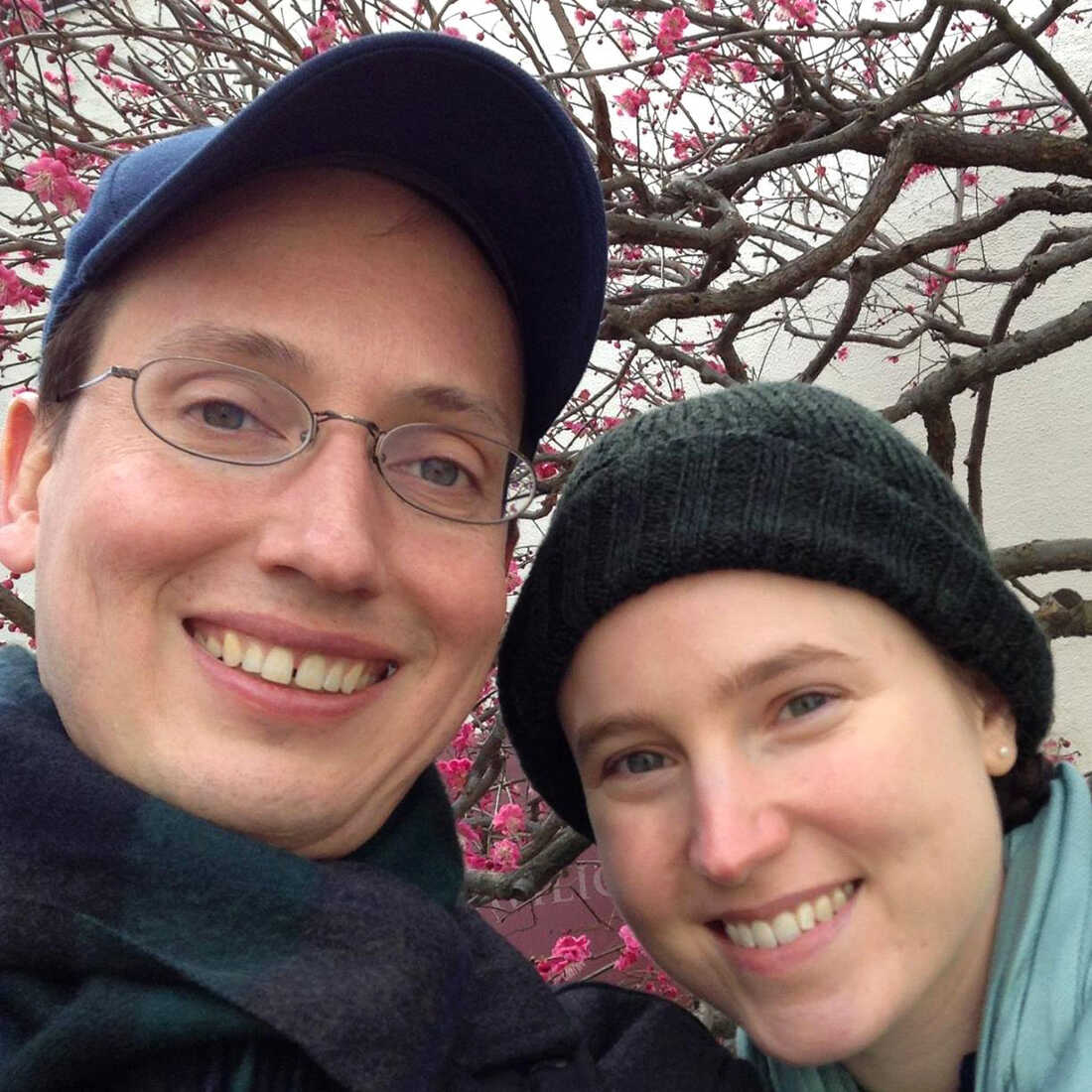
Tim Goliver and his wife, Christine, last year in Washington, D.C. Goliver was 21 when he first developed a stomach issues, and then Guillain-Barre. Courtesy of Tim Goliver hide caption
toggle caption
Courtesy of Tim Goliver
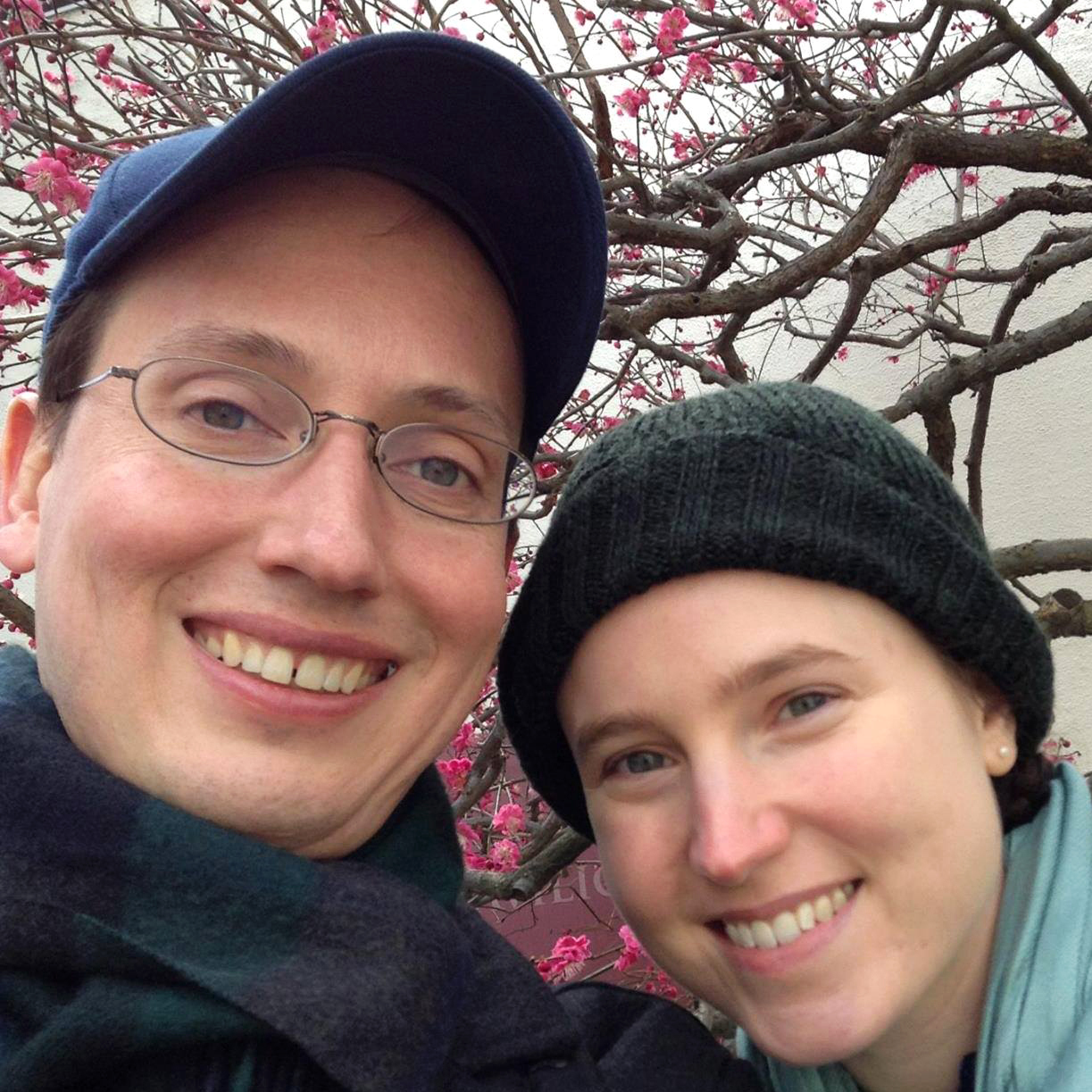
Tim Goliver and his wife, Christine, concluding year in Washington, D.C. Goliver was 21 when he first developed a stomach bug, and and then Guillain-Barre.
Courtesy of Tim Goliver
"I was simply completely unable to movement and I but would watch the same episode of Sports Heart again and once more on replay and experience like I was in a loop and things were totally out of control," says Tim.
When friends and family came over, they'd communicate to him with a poster full of letters, slowly dragging their fingers beyond each alphabetic character until Tim nodded or blinked to indicate he wanted to use it to spell something out. It could take 10 minutes to spell out one discussion.
For weeks, he lay paralyzed and silent, fed through a tube. When he did start breathing on his own again, Tim says, each breath was so nervus-racking it felt similar he was about to fall off the edge of a cliff.
"Just bit past bit, it got to the betoken where I was able to practice that and it felt similar I was in control," he says. Tim spent two months in the intensive intendance unit of measurement and 2 months in rehab, and so went home in an electrical wheelchair.
Luther lost mobility, also, and spent weeks in intensive care. But he was able to breathe and talk the whole time.
"I retrieve my sis saying, 'GBS took everything else away but didn't take his mouth abroad,' " says Luther, laughing.
During his years in the military, Luther had routinely aced the physical fitness tests. He trained about 2,000 recruits and sent them off on their military careers. There'due south an onetime saying, "the more you sweat in peace, the less you drain in war," he says.
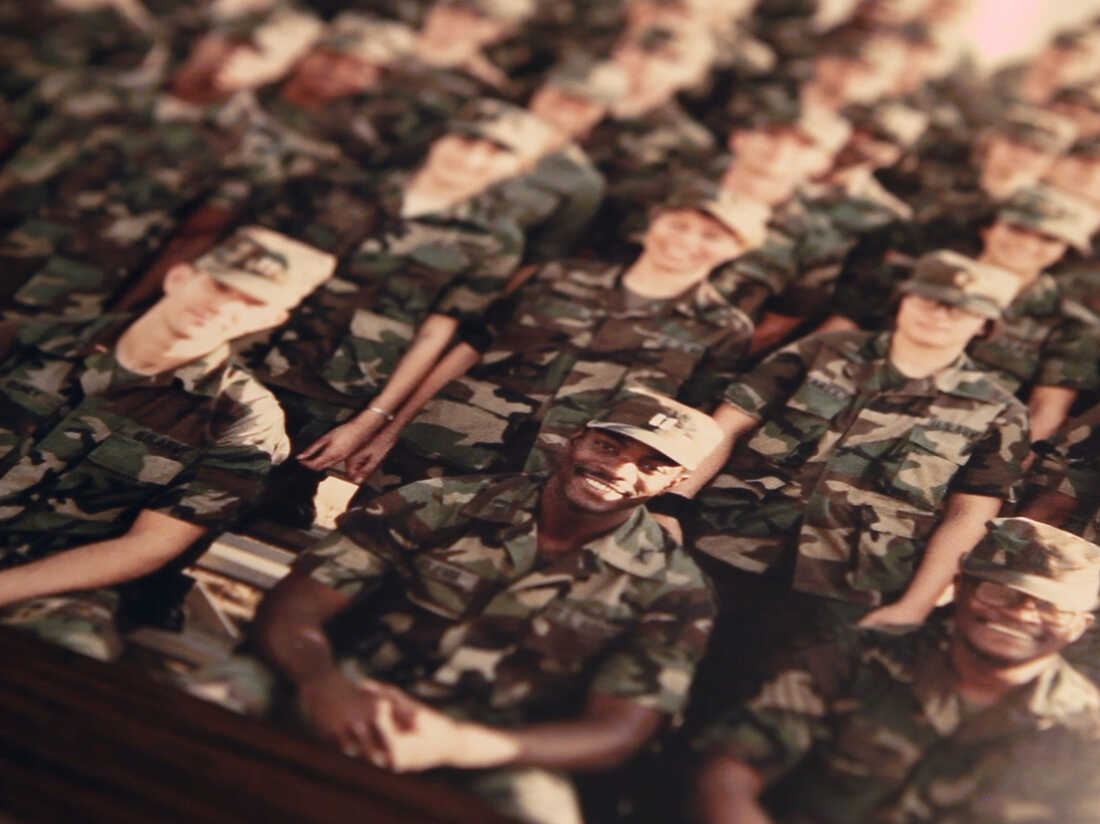
Luther trained recruits in the military machine. Meredith Rizzo/NPR hide caption
toggle caption
Meredith Rizzo/NPR

Luther trained recruits in the military.
Meredith Rizzo/NPR
"The military gave me the idea that I could do simply well-nigh annihilation, then when I was in the hospital, I looked at this illness as only some other mission that I had to accomplish," says Luther.
He loved existence in shape because it was the 1 thing he knew he could control, but Guillain-Barre syndrome fabricated him and so weak that he couldn't even blink. When he roughshod asleep, his eyes would simply gyre back in his head. The nurses had to put gel on his optics so they wouldn't dry out out at night. After six weeks in the hospital, he saw himself in a mirror for the kickoff time.
"And when I looked up, I was shocked. I was floored that that was me — this thin, gaunt guy. That was probably more shocking to me than anything," he says.
He'd lost virtually xxx pounds. For his birthday, the nurses pureed a cake for him, because his confront and throat muscles were also weak to chew and swallow solid nutrient. "It was horrible, simply I loved them for it," he says.
For a while, things did not look good — he wasn't making any progress toward moving again. But when a doctor told Luther that well-nigh people fully recover, that gave him hope. "It's on. I got this, Doc," he said. "GBS done messed with the incorrect person."
Every nighttime he'd give himself a pep talk, repeating a line from a song. " 'Nobody told me the road would be like shooting fish in a barrel, but I don't believe He brought me this far to leave me.' Just say that every night. Every nighttime," he says.
I solar day, Luther moved his paw always so slightly. Then a muscle twitched in his leg. A few days after, he blinked. After months in the hospital, he was transferred to rehab, where he learned how to move around in a wheelchair.
Finally he was able to return to the house that had been total of boxes when he left nigh six months before. He had to alive in the basement because he couldn't get upwards the stairs. His progress at home was excruciatingly slow.
"Days start running into weeks, weeks start running into months," he says.
Luther was not one of the lucky 80 pct. He'southward in the twenty percent of GBS patients who don't recover fully. For the well-nigh function, he'due south independent. He lives in his own flat at National Harbor near Washington, D.C. An aide stops by three times a week to aid out with cleaning and cooking. He goes out to movies and dinner with his family in an electric wheelchair. He loves to read on a dock at the harbor. He's even learning Spanish. But he all the same tin can't accept more than a few steps with a walker, and just moving his face enough to talk can feel similar a muscular feat.
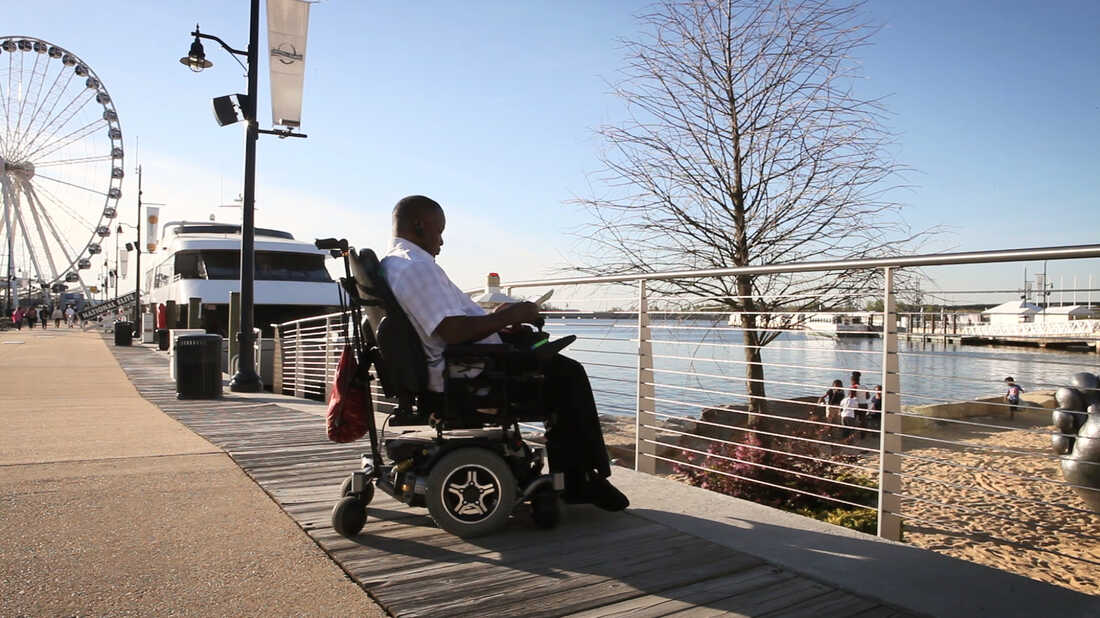
Luther checks out the waterfront almost his domicile in National Harbor, Md. Meredith Rizzo/NPR hide explanation
toggle explanation
Meredith Rizzo/NPR

Luther checks out the waterfront near his dwelling house in National Harbor, Physician.
Meredith Rizzo/NPR
"Ane of the things I hate the almost is that I lost my ability to smile. Information technology's hard for me to do. Information technology looks nigh like a grimace," he says.
Information technology'southward been six years since he first got sick.
"Information technology doesn't dishearten me, but I realize this just might be my plight, and so I take a grin with me and let's go. Make the best of it," he says.
Tim, on the other hand, recovered almost fully. He quickly regained his ability to talk and work. He went back to school and got his caste. He even proposed to his wife at the peak of a mountain.
"At the indicate where I started to walk up mountains again without pain, I felt that I had conquered the actual experience. I look at information technology at present and I don't run into anything that it'due south keeping me from doing," says Tim.
He has leather braces to stabilize his ankles, some tingling in his feet, and a very small scar on his throat from the ventilator, a mark from when he hitting rock bottom. That'due south about it.
Why did Tim recover so much more office than Luther did? And why did the 2 of them get Guillain-Barre syndrome when so many other people who were exposed to the same bugs didn't?
"Unknown," says neurologist Gorson. "There's clearly an interaction between the infectious agent, the immune response, and and then something that'south special or unique about the patient's peripheral nerve system," he says. Sometimes it has to exercise with age, medical care, how much nerve damage happened, or even the kind of leaner or virus that acquired the illness in the offset place.
Predicting how much a patient will recover is ane of the things Gorson and other neurologists are trying to figure out. They're collecting claret from over i,000 people around the world, hoping to find out what triggers some people'due south immune systems to react in such an extreme manner. Information technology might lead to better treatments, or maybe even something they can do to stop the progression of the affliction before it gets and then bad.
If the Zika virus does begin spreading through the U.South. as predicted, there may exist more cases of Guillain-Barre syndrome. The condition will withal remain rare, but fifty-fifty a slight increase in cases could be horrible — not just for the people who get it, simply likewise due to the strain it puts on hospital intensive care units and insurers.
"I cost over a million dollars, and that is something I take never forgotten," says Tim.
Tim and Luther did not get Guillain-Barre from Zika. But the result is the same. And if their cases evidence anything, it's that no affair what the crusade, the disease is one wild ride.
Source: https://www.npr.org/sections/health-shots/2016/05/16/476494277/suddenly-paralyzed-two-men-struggle-to-recover-from-guillain-barre
0 Response to "If Someon Gbs Will They Breathe on There Own Again"
Enregistrer un commentaire